Is Your Underperforming Sales Rep a Talent Problem or a Coaching Problem?
Quick answer: Most sales managers judge a rep on one thing: are they hitting number. That's only half the picture. Look at two things instead, whether they're getting results and whether they're getting those results the right way, and you'll know within minutes whether a rep needs a real coaching plan, a shorter leash, or a different seat entirely.
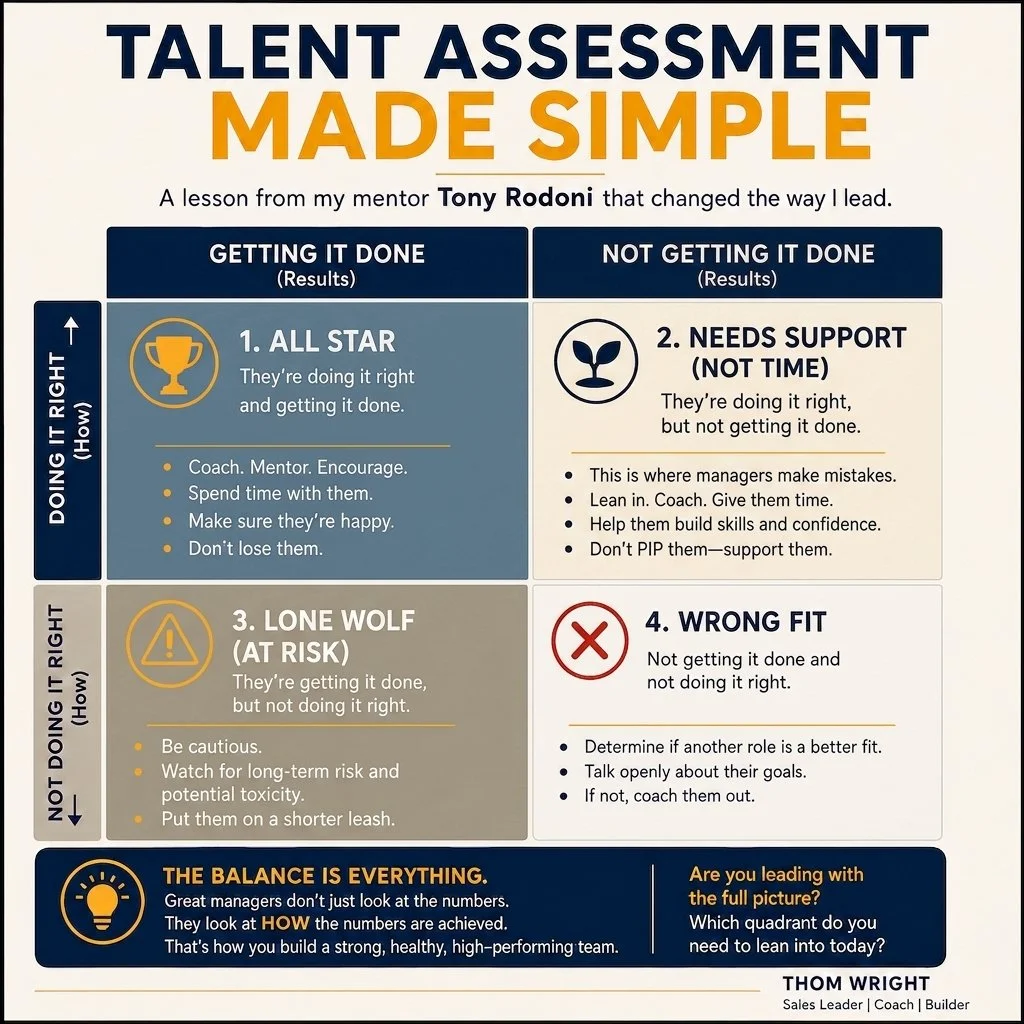
The whiteboard moment that changed how I manage people
Early in my sales management career, I sat down with my mentor Tony Rodoni and admitted something I wasn't proud of. I was frustrated that not every account executive on my team looked and sold like me. I'd been a top performer as an individual contributor, so my plan for building a great team was simple: find more people like me. It didn't work. The reps who didn't think or talk or sell the way I did frustrated me, and I frustrated them right back trying to manage them like copies of myself.
Tony grabbed a marker and drew a 2x2 box on his whiteboard.
One axis was getting it done. The other was doing it right.
"That's really all you need to look at when you're assessing talent," he said.
Getting it done means the rep is booking revenue and hitting their number. Doing it right means they're building pipeline the right way and doing the work that keeps the business healthy for the long run, not just chasing a number however they can get it.
Most managers only ever look at the first one. That's how you end up firing people who just needed a real plan, and keeping people who are quietly doing damage while the scoreboard looks fine.
The four types of reps on every sales team
All Star — getting it done and doing it right. This is your top performer, and the mistake managers make here isn't a management mistake, it's a retention mistake. Coach them, spend real time with them, and do whatever it takes to keep them. It's easy to leave your best people alone because they don't need you. That's exactly when you lose them.
Lone Wolf — getting it done, not doing it right. This is the quadrant that hides the longest, because the number looks good. Watch how the rest of the team talks about this person, and whether their shortcuts start showing up in how other reps behave. A lone wolf who's tolerated because of their number is one of the fastest ways to quietly poison team culture.
Needs Support, Not Time — doing it right, not getting it done. This is where most managers get it wrong. They see a missed number and reach straight for a performance improvement plan. Don't. This rep is usually doing the right activities and just needs help, time, or coaching in one specific spot. The test isn't how much time has passed. The test is whether there's an actual plan behind that time, or whether you're just hoping it fixes itself.
Wrong Fit — not getting it done and not doing it right. This is a fit problem, not a will problem. Sometimes the answer is finding them a different seat, inside your team or outside it. If that's not realistic, the respectful move is coaching them out directly instead of letting it drag on.
What a real plan actually looks like, not just a PIP
That third quadrant, doing it right but not getting it done, is personal for me. Early in my own career as a mid-market seller at Salesforce, my manager Rachel put me on a PIP. It gutted me. I thought my career was over.
But Rachel did something most managers don't do. She told me she knew why I was on the PIP, and she also told me she knew I was better than the number I was posting. Then she backed that up. We met every single week to review the plan, and she gave me real coaching, not just a scorecard. Five weeks later I was off the PIP, and I was never on one again for the rest of my career, as a seller or as a leader.
That experience is a big part of why I run PIPs the way I do now. I've built a real checklist for what it takes to get off one, the same way I build a 30- and 60-day checklist for new hires, and I sit down with a rep every week to work it, not just check in at the end. My own PIP success rate, reps who actually get off the plan, sits around 50 percent. That's not because I'm soft. It's because most of the reps who end up there are in the "doing it right, not getting it done" quadrant, and what they need is a real plan, not a countdown cloc
Should I put an underperforming rep on a PIP right away?
Not automatically. First figure out which quadrant they're actually in. A rep who's doing the right activities, building pipeline, running a real process, and still missing number is a different problem than a rep who's cutting corners and skating by. The first one usually responds to coaching and a real plan. The second one usually needs a much shorter leash, or the PIP conversation moves faster. Skipping this diagnosis is how good reps get pushed out and problem reps get missed.
What does "doing it right" actually look like day to day?
It's less about a specific methodology and more about whether the fundamentals are real. Are they building pipeline the honest way, or manufacturing activity that looks good on a dashboard. Are they running a legitimate sales process, or skipping steps to force a number. Are they honest in their forecast, or telling you what you want to hear. "Doing it right" is really a proxy for whether the business stays healthy if this rep is still here in a year.
What do I do with a rep who's hitting their number but hurting the team?
Watch first, don't wait forever. The lone wolf quadrant is the one leaders let slide longest because the revenue makes it easy to look away. Pay attention to how the rest of the team talks about that person, whether other reps start copying the shortcuts, and whether customers or peers are quietly raising flags. A short leash means clear expectations and a real conversation now, not a wait-and-see approach that only ends once the damage is already done.
The balance is the whole point
Great managers don't just look at the number. They look at how the number got made. That's the difference between a team that's actually healthy and a team that looks fine right up until it isn't.
If you're sitting on a review right now and you're not sure which quadrant a rep is actually in, that's exactly the kind of blind spot a second set of eyes catches fast. That's a lot of what shows up in 1:1 coachingwith frontline and second-line sales leaders, working through the specific person, not just the framework.